Showing posts with label Digital Region. Show all posts

Wednesday, November 10, 2021

News: Rotherham broadband firm crashed with £38m in debts

By

Investors in a failed Rotherham-based broadband firm were hoping to make a return with a five-year expansion strategy, instead it called in administrators after Origin Broadband burnt through half a million pounds a month.

Rothbiz reported last month that Origin Broadband had become part of TalkTalk following a sale out of administration.

Launching in 2011, Origin developed its own infrastructure and hosted the sixth largest broadband network in the UK. Supplying phone and internet services to businesses and homes across the UK (with around 80,000 customers), it switched between premises in Rotherham town centre and in Manvers.

Gareth Harris and Jamie Miller of RSM Restructuring Advisory were appointed as joint administrators on September 24 2021.

The administrators have recently published an update on their proposals which details how the company struggled with issues with "customer churn, low average revenue per user and bad debts leading to a contraction in customer base."

London-based Faro Capital, a private equity investment company, acquired Origin in 2018 and invested around £25m to date since its original investment, which inlcuded around £4m of legacy liabilities through placing the company through a Company Voluntary Arrangement (CVA).

Advertisement
Faro's investment was to used to boost the customer base from 20,000 to 80,000 and fund ongoing losses.

The administrator's report states that management had identified that the company should be at a break even point with a customer base of 85,000 but administrators highlighted that this was unrealistic when putting together information to go out to potential investors.

The report adds that Faro was hoping for investment via debt funds and were optomistic of the five-year expansion strategy based on growing the customer base at material cost to generate a significant return. However administrators said that "they were becoming increasingly concerned about the company's finacial performance (in particular the level of cash consumption)."

Indeed, during the period May to July 2021, the company consumed cash of £500,000 per month from a customer base of 80,000, indicating that the company was much further away from the break even point. Administrators said that this was due to "dissapointing customer retention" which led to spending on replacement customers. Faro then concluded that it could not continue funding the current business and a sale was pursued.

22 bidders looked at buying Origin and eventually three parties competed to secure the assets. A deal was struck for Origin's customers, and around 100 staff, to move over to TalkTalk, the UK's leading value for money consumer and B2B telecoms provider, which is based in Salford.

Faro was the company's secured creditor and were owed some £27m. The sale was agreed for £17.8m and meant that Faro can expect £17.6m as a result.

Vodafone was Origin's biggest unsecured creditor and has been left out of pocket for around £8m.

Images: Origin

Read more...

Thursday, April 14, 2016

News: Internet Bliss for Rotherham village

By

Local tech entrepreneur, Chris Foulstone, has shown his initiative and brought the entire Rotherham village of Treeton up to speed by creating its very own internet service provider (ISP).

Following the collapse of Digital Region in 2014, web developer Chris realised it could be many years before Treeton received the high speed internet connections promised by the project and was left with no other option but to relocate his business – sharing office space with Holbrook-based HA Hosting, which operates a data centre in the city.

During the time Chris spent working at the data centre, he began researching alternatives and following discussions with the owners, he realised it may be possible to give all residents and businesses in Treeton a chance to access superfast broadband for the first time.

Drawing on his technical expertise and knowledge, Chris pioneered an idea to bring the superfast broadband speeds enjoyed in many areas of South Yorkshire to Treeton. The idea was a simple one: build a direct link from the data centre, which could be shared wirelessly, allowing the superfast broadband speeds to be achieved.

For the past twelve months Chris has spent time developing his idea. He has invested profits from his web development company into building a new mast in Treeton, which connects to the data centre and following a successful trial, he has launched Bliss Internet.

Advertisement
Available exclusively to residents and businesses living in Treeton, Bliss has already secured 250 customers, a figure which is growing by approximately ten new users each week.

When Digital Region was switched off, Treeton and many other small villages went from having speeds in excess of 40mbps to below 2mbps overnight. The result of Chris' innovative work has seen broadband speeds increase tenfold for Treeton residents and if the venture proves to be a success, Chris believes the service could be rolled out to other remote areas where superfast broadband connections can't currently be accessed.

To provide additional stability to the new network, Chris and HA Hosting have also successfully installed a dedicated fibre optic line in Treeton, which provides additional stability to the growing network.

Chris Foulstone, founder, Bliss Internet said: "Superfast broadband speeds are something which many of us take for granted, but in areas which aren't connected it can often be a very frustrating experience. The slow speeds were impacting on my own business and it meant that it was virtually impossible to work from Treeton.

"When I temporarily relocated my business to HA Hosting, I realised that with a little technical expertise and a bit of imagination, the problems could be solved and everyone in the community would benefit.

"The result is a genuine first which has not only meant that I'm able to continue running my business in Treeton, but we've created a solution where everyone in the village benefits. The solution we've developed is something which could be replicated in other areas which aren't connected to the UK's superfast broadband network and delivered at a fraction of the cost of upgrading the existing phone network."

Rory Delahoyde, director at HA Hosting, added: "Chris and his team have put in a tremendous amount of work over the last year or so to make this work for the people of Treeton. They have overcome many obstacles to provide a reliable, fast internet service to their customers. It is great to see more and more people from Treeton adopting the Bliss Internet Service."

Bliss Internet website
HA Hosting website
Impelling website

Images: Impelling / Bliss Internet

Read more...

Friday, May 1, 2015

News: Businesses set to benefit from broadband boost

By

Small businesses in Rotherham are now able to apply for grants of up to £3,000 each to boost their broadband service.

Local councils have been successful in accessing the Government's broadband connection voucher scheme, which is to be extended for a further year. Each voucher covers up to £3,000 of installation costs but businesses can also apply as a group to connect bigger or more complicated premises. Once installed, businesses pay the line rental and VAT.

The Government announced that it was extending its SuperConnected Cities scheme and that more areas would be able to access the vouchers in the Autumn Statement 2014, to be funded through a £40m Challenge Fund operating on a first-come first-served basis and running until March 2016.

At the same time, contracts have been signed for a £22m project to ensure 97.9% of South Yorkshire will have access to superfast broadband by the end of 2017.

Developed by a partnership with the leadership of the four partners' authorities in South Yorkshire, alongside the support of the Sheffield City Region Local Enterprise Partnership (LEP), the project is part of the government's BDUK initiative which is based on a gap funded subsidy approach, where the private sector invests alongside a public subsidy to provide broadband to areas where there is not otherwise a viable commercial market.

Due to its involvement in the failed Digital Region project, South Yorkshire is the last in this current round of BDUK, the government project with the goal of delivering a fibre point in every community in the UK by the end of 2015.

The core contract for the new Superfast South Yorkshire broadband project will cover over 102,000 residential and business premises across eight delivery phases. The first cabinet is anticipated to go live in November 2015, and the final phases will be completed by the end of 2017.

Detailed surveys and designs are being carried out in order to finalise the deployment plan, which will be made public as soon as available so that households and businesses can understand when the deployment will reach them.

Culture Secretary Sajid Javid said: "This is fantastic news for South Yorkshire as we know how important a fast broadband connection is for businesses across the UK. We want to make sure that small businesses have the technology they need to compete in the digital age. This scheme will help tens of thousands of small businesses around the UK and I urge all South Yorkshire businesses to apply for a voucher from April 2015 onwards."

Recommended reading: Is Fibre Necessary for Your Business in Rotherham?

Cllr. Leigh Bramall, Cabinet Member for Business, Development and Skills at Sheffield City Council, added: "The South Yorkshire Local Authorities have long recognised the importance of broadband as an enabler of economic growth. We are keen to support as many of our small and medium sized businesses to access the connection vouchers and to realise the business benefits of being better connected.

"We believe that superfast broadband connectivity is essential for building a strong and competitive economy to support economic growth, open up new markets, attract investment and contribute to more and better jobs in the region."

Superfast South Yorkshire website

Images: Superfast South Yorkshire

Read more...

Wednesday, March 25, 2015

News: Broadband boost for business parks

By

Enterprises Zones (EZs) and business parks in South Yorkshire could be in line for the fastest broadband speeds if regional funding can be secured.

Contracts have been signed for a £22m project to ensure 97.9% of South Yorkshire will have access to superfast broadband by the end of 2017.

Developed by a partnership with the leadership of the four partners' authorities in South Yorkshire, alongside the support of the Sheffield City Region Local Enterprise Partnership (LEP), the project is part of the government's BDUK initiative which is based on a gap funded subsidy approach, where the private sector invests alongside a public subsidy to provide broadband to areas where there is not otherwise a viable commercial market.

Due to its involvement in the failed Digital Region project, South Yorkshire is the last in this current round of BDUK, the government project with the goal of delivering a fibre point in every community in the UK by the end of 2015.

BT's tender for the project was accepted and the councils have already agreed to fund the project in order for the contracts to be signed to meet BDUK deadlines. The LEP agreed earlier this month that their share can be met by the Sheffield city region investment fund for strategic infrastructure investment (SCRIF).

The bid was for £8m from SCRIF with £8m from BDUK and £7.56m coming from BT.

However, £10.4m has been made available from BDUK and the project delivery team have been actively exploring the opportunities to extend the broadband speeds offered on key business parks and EZs to guarantee the best speeds possible. It is proposed that the remaining £2.4m, which is not currently proposed to be used in the core programme, could be used to support a proposal specifically for the South Yorkshire Enterprise Zones and key strategic business parks.

When further SCRIF money becomes available, the broadband project is set to get the first call for extra match funding.

The core contract for the Superfast South Yorkshire broadband project will provide 97.9% coverage of superfast broadband, covering over 102,000 residential and business premises across eight delivery phases. The first cabinet is anticipated to go live in November 2015, and the final phases will be completed by the end of 2017.

Detailed surveys and designs are being carried out in order to finalise the deployment plan, which will be made public as soon as available so that households and businesses can understand when the deployment will reach them.

BT has also been presented with prioritised lists of business locations for consideration of how the sites can achieve maximum coverage and/or be brought forward in the programme to meet BDUK requirements. BDUK have always necessitated that EZs must be a priority and be early in deployment plans.

Fibre to the cabinet will be the main technology used which can deliver speeds of up to 80Mbps to households. Fibre to the premises technology − delivering ultra fast speeds of up to 330Mbps - will also be used in some areas.

Superfast South Yorkshire website

Images: Superfast South Yorkshire

Read more...

Wednesday, March 4, 2015

News: Rotherham's Digital Region costs stand at £8.2m

By

Rotherham Council is expecting to pay out £8.2m to cover its share of the costs of the failed Digital Region superfast broadband project.

The council, along with the other three authorities in South Yorkshire joined with the now defunct regional development agency Yorkshire Forward in 2006 to progress plans to bring continuous 25mb+ broadband to over 97% of South Yorkshire. At the time it was clear that BT had no plans to upgrade its own network in the region.

A combination of delays in appointing a contractor to build and run the network, failing to adjust as necessary in a fast-moving business sector and zero income risk being allocated to the network operator made the business hopelessly uncompetitive.

With only 3,000 of the 100,000 customers it needed, the remaining shareholders agreed to halt their search for a private sector partner and begin a managed closure of the fibre optic network. The network was switched off last year.

At the first meeting of the new commissioners, brought in by the government to take over the executive functions of the council that was deemed "not fit for purpose," Stuart Booth, interim strategic director of resources and transformation, was quizzed on the council's ongoing capital programme.

The council's capital expenditure includes an estimated £6.2m to cover its costs of closing down Digital Region Ltd which can be added to the initial £2m capital loan at the start of the project.

The money, which has been found as the council puts forward a budget with further savings of £23m, has been created using capitalisation. Capitalisation is where the Government permits councils, in special circumstances, to treat revenue costs as capital costs. This increases their flexibility, because they can then meet those costs using their existing borrowing powers or capital receipts, for example, from asset sales.

Estimates from Sheffield Council put the cost of closure at £83m and Rothbiz revealed last year that Rotherham Council had budgeted an additional £7.58m of support on top of the original £2m of capital loans. The shareholders had to agree to provide sufficient funds to enable services to be migrated without interruption of business and to enable the company to meet its debts.

Following the closure of Yorkshire Forward, the government had to agree to provide at least 45% of the funding (up to £45m) to cover a significant proportion of the repayment of the ERDF grant which has to be paid back to Brussels, because the original conditions were not fulfilled. It will also pay a proportion of the contract due to the original operator, Thales.

Booth explained at the meeting that the estimated cost of closing down the company has been reduced and that liquidators are expected to be appointed soon.

Auditors, KPMG, published an independent review into the local authority involvement in the Digital Region project. It found that key council decisions on whether to invest were based on a business case full of assumptions with a lack of a robust sales and marketing plan.

Auditors also found that the business case did not fully show value for money, board members put forward by councils did not include any IT specialists, council reports failed to fully show the importance of achieving rapid take-up of services to the financial success of the project, and that there did not seem to be a clear exit strategy as the project became more problematic and a positive outcome became more unlikely.

Rotherham Council's revenue and capital budgets are expected to receive official approval at a full council meeting today.

Images: Digital Region

Read more...

Tuesday, February 17, 2015

News: Broadband money coming down the line

By

The £22m project to ensure 97.9% of South Yorkshire will have access to superfast broadband by the end of 2017, has cleared another hurdle in securing the public money needed to make it happen.


Developed by a partnership with the leadership of the four partners' authorities in South Yorkshire, alongside the support of the Sheffield City Region Local Enterprise Partnership (LEP), the project is part of the government's BDUK initiative which is based on a gap funded subsidy approach, where the private sector invests alongside a public subsidy to provide broadband to areas where there is not otherwise a viable commercial market.

Due to its involvement in the failed Digital Region project, South Yorkshire is the last in this current round of BDUK, the government project with the goal of delivering a fibre point in every community in the UK by the end of 2015.

Rothbiz revealed first that BT's tender for the project was accepted and the councils have already agreed to fund the project in order for the contracts to be signed to meet BDUK deadlines. It is hoped that their share can be met by the LEP's Sheffield city region investment fund for strategic infrastructure investment (SCRIF).

The bid is for £8m from SCRIF with £7.56m coming from BT.

SCRIF brings a range of funding streams together to deliver essential strategic infrastructure to increase economic growth and jobs in the Sheffield city region. The broadband project is making its way through the assessment and prioritisation approach and is concluding "Stage 1A" of its development which tests the commercial viability of a scheme and reviews the deliverability and strategic fit.

Set to be approved this week, the project will then go onto Stage 1B which includes further work to develop a full business case. The Sheffield City Region Combined Authority has asked that this includes a number of conditions that need to be met before a funding agreement is reached. These include details of the full extent of the market coverage, clarification over the BDUK funding and details of the market's plans for broadband in the region.

Other issues to be addressed focus on the economic impact of the project, analysis of the demand for broadband, BT's winning bid and whether it offers value for money, and a detailed business plan to provide confidence on delivery of the roll-out programme.

The later stages of the process for securing the funding include tendering and procurement, but in the case, this is already complete.

The first communities across South Yorkshire can look forward to improved access to online services and better connectivity for businesses from summer 2015 onwards. It is hoped that 20,000 premises will be passed by the end of 2015/16.

Auditors, KPMG recently published a report on the same four councils' involvement in the failed £90m Digital Region project which had many assumptions in the business case that were never close to being realised and no robust and coherent sales and marketing plan, especially early in the process.

Superfast South Yorkshire website

Images: BT

Read more...

Thursday, January 22, 2015

News: Auditors publish review into failed Digital Region project

By

Key council decisions regarding the failed £90m Digital Region broadband project in South Yorkshire were based on a business case full of assumptions with a lack of a robust sales and marketing plan.

Auditors, KPMG, have published an independent review into the local authority involvement in the project, which was switched off last year, and also found that the business case did not fully show value for money, board members put forward by councils did not include any IT specialists, council reports failed to fully show the importance of achieving rapid take-up of services to the financial success of the project, and that there did not seem to be a clear exit strategy as the project became more problematic and a positive outcome became more unlikely.

Rotherham Council, along with the other three authorities in South Yorkshire joined with the now defunct regional development agency Yorkshire Forward in 2006 to progress plans to bring continuous 25mb+ broadband to over 97% of South Yorkshire. At the time it was clear that BT had no plans to upgrade its own network in the region.

The project was financed by contributions from local authorities and included £30m from the European Regional Development Fund (ERDF). Work on installing the Digital Region network started in 2009, and by 2012, completion of phase one of the project saw 80% of homes and businesses within South Yorkshire able to be linked to the network.

A combination of delays in appointing a contractor to build and run the network, failing to adjust as necessary in a fast-moving business sector and zero income risk being allocated to the network operator made the business hopelessly uncompetitive. In 2013, shareholders agreed to halt their search for a private sector partner and begin a managed closure of the fibre optic network.

KPMG was commissioned by the councils to review the whole project cycle, from initial decision to invest to the decision to close the company. It comes after another broadband project was signed off by the same councils which will see BT deliver superfast broadband to 97.9% of South Yorkshire by the end of 2017.

The independent review's observations highlighted that the external reviews of the business case, which was drawn up by external consultants, carried out as part of the original due diligence raised concerns and issues, "which would be expected from such reviews." The business case included assumptions and projections of income that never came close to being realised. The review states: "There were many assumptions in the business case, for example around the technology developments and the financial projections. With the benefit of hindsight, a significant number of these fundamental assumptions were not realistic and did not come to reality."

Another issue was the lack of a robust and coherent sales and marketing plan, especially early in the process. Reports show that Thales, the contractor procured in 2009 to build and operate the network, would also provide sales and marketing services. Thales disputed this and by 2010 contractual notices were issued and Digital Region re-negotiated the contract in 2011 with Thales, reducing costs and transferring sales and marketing responsibility to Digital Region.

KPMG stated that "the lack of a robust sales and marketing plan earlier in the process did not help the Councils and DRL to demonstrate the achievability of the business plan."

When the Government were forced to step in and provide at least 45% of the funding to cover a significant proportion of the repayment of the European grant, it was revealed that Digital Region had only secured 3,000 of the 100,000 customers it needed.

Advertisement
There is evidence that the aims of the project, including more people accessing high speed broadband, have to some degree been achieved – albeit not necessarily by Digital Region itself.

The key findings from the review report have been accepted by the leaders of the four South Yorkshire local authorities. Meeting minutes state that Sheffield Council admits that it "knowingly entered into considerable commercial risks. However, technological advances, market conditions and delays in obtaining European approvals all contributed to making the project fail commercially."

It adds: "It is true to say that if this project (and many others which Councils consider on a daily basis) were low risk from the outset, then they would likely be delivered by the market without there being a case for public sector intervention. We were trying to make a step change well ahead of a private sector solution and in doing so, knowingly entered into considerable commercial risk."

Assets were sold to Geo Networks, part of the American Zayo Group, and the cost of closing down the network was estimated to be £83m. Costs to date are thought to be lower than the worst case budget.

Rotherham Council set aside £9.58m to cover its share of the costs of the failed project. KPMG identified issues over value for money and a residual audit risk with the arrangements for the closure of Digital Region Ltd in 2014, later concluding that the authority "made proper arrangements to secure economy, efficiency and effectiveness in the closure of Digital Region Ltd."

Images: Digital Region

Read more...

Monday, September 22, 2014

News: Councils sign up for BT broadband

By

Local authorities have signed a contract with BT to deliver superfast broadband to 97.9% of South Yorkshire by the end of 2017.

Developed by a partnership with the leadership of the four partners' authorities in South Yorkshire, alongside the support of the Sheffield City Region Local Enterprise Partnership (LEP), the £22m plan is part of the government's BDUK project which is based on a gap funded subsidy approach, where the private sector invests alongside a public subsidy to provide broadband to areas where there is not otherwise a viable commercial market.

Rothbiz revealed first that BT's tender for the project was accepted. £7.56m is expected to be provided by BT and £7.425m each by South Yorkshire partners and BDUK. Public sector payments will only be made when certain milestones are met.

The councils had to agree to the funding in order for the contracts to be signed but it is hoped that their share can be met by the LEP's Sheffield city region investment fund for strategic infrastructure investment (SCRIF).

Rotherham council's contribution so far includes £1.596m in order to allow a contract to be signed and a contribution to a contingency budget of £124,000 and £112,500 towards the costs of employing staff to manage the provision of superfast broadband to the rest of the region.

Bill Murphy, managing director at BT Group, said: "Superfast broadband is a key part of the present and future success of the whole of South Yorkshire. The technology is vital to modern life whether you are a high-tech start-up or an established family firm in a traditional industry such as manufacturing. It will become even more essential in the increasingly "connected world" of the future.

"Fibre broadband is now becoming essential for consumers too. Existing broadband is struggling to support the growing number of web based devices in the home. All these devices will be competing for the same limited bandwidth, and basic broadband services with slow speeds will increasingly become a major bottleneck."

James Newman, chairman of the Sheffield City Region LEP, added: "I am delighted that the four South Yorkshire authorities have taken this important step towards reinforcing the Sheffield City Region’s reputation as one of the best places in the country to live, work and invest.

"We have heard time and again from businesses that superfast broadband is no longer a "nice to have", but essential to their competitiveness and long term sustainability.

"I would like to extend my thanks to the four authorities for really taking on board the needs of the private sector, and congratulate them on reaching this important deal with BT."

BT were the only bidders for the contract and will be contractually committed to the 97.9% figure, although specific areas and properties are not yet known. The roll-out plans will be announced in the coming months, following a period of surveying and planning. The first communities across South Yorkshire can look forward to improved access to online services and better connectivity for businesses from summer 2015 onwards.

In a bid to boost business, BT's proposed solution is also set to cover approximately 79% of the South Yorkshire business parks and Enterprise Zones put forward as part of the tender exercise. It is estimated that the project could boost the economy by £271.6m. Rotherham Council believes the Rotherham Borough area "will do very well in respect of its Enterprise Zones and business parks, indeed better than the three other South Yorkshire local authority areas."

Due to its involvement in the failed Digital Region project, South Yorkshire is the last in this current round of BDUK. A combination of delays in appointing a contractor to build and run the Digital Region network, failing to adjust as necessary in a fast-moving business sector and zero income risk being allocated to the network operator made the business hopelessly uncompetitive.

With only 3,000 of the 100,000 customers it needed, the remaining shareholders agreed to halt their search for a private sector partner and begin a managed closure of the fibre optic network. The network was switched off on August 14 and assets are being sold to Geo Networks, part of the American Zayo Group.

Images: BT

Read more...

Friday, August 8, 2014

News: Rotherham funding approved for BT broadband contract

By

Councillors have made assurances that Rotherham will get a good deal out of the new £22m superfast broadband project after their decision to approve up front funding came under further scrutiny.

Developed by a partnership with the leadership of the four partners' authorities in South Yorkshire, alongside the support of the Sheffield City Region Local Enterprise Partnership (LEP), the plan is set to enable 97.9% of South Yorkshire to have access to fibre broadband by the end of 2017.

Like other local authorities, Rotherham Council has agreed to underwrite the required local funding contribution of £1.596m in order to allow a contract to be signed with BT in August. It is also set to contribute a contingency budget of £124,000 and £112,500 towards the costs of employing staff to manage the project.

BT were the only bidders for the contract and will be contractually committed to the 97.9% figure, although specific areas and properties are not yet known. The focus is on so called "white areas" that do not have access to next generation (fibre optic) broadband and are not likely to in the next three years.

In a bid to boost business, BT's proposed solution is also set to cover approximately 79% of the South Yorkshire business parks and Enterprise Zones put forward as part of the tender exercise. It is estimated that the project could boost the economy by £271.6m. Rotherham Council believes the Rotherham Borough area "will do very well in respect of its Enterprise Zones and business parks, indeed better than the three other South Yorkshire local authority areas."

The broadband scheme is seeking £8m of funding from the Sheffield city region investment fund for strategic infrastructure investment (SCRIF) but the contract needs to be signed now to meet deadlines set by the Government's BDUK programme.

Opposition councillors wanted BT to cover the costs and wanted more information on the contract - the risks involved and the areas of Rotherham that are set to benefit.

Due to its involvement in the failed Digital Region project, South Yorkshire is the last in this current round of BDUK, the government project with the goal of delivering a fibre point in every community in the UK by the end of 2015. The project timescale "has caused a certain amount of stress which is beyond the control of the four local authorities of South Yorkshire" with the decision on SCRIF, to be made by the Sheffield City Region Combined Authority, not due until November.

Cllr. Ken Wyatt, cabinet member for finance, said: "This project is the second or third highest priority of the Sheffield City Region Combined Authority. All of the technical and financial details have been assessed and the coalition Government's legal experts have completed the due diligence tests. It would be perverse if the SCRIF monies were not ultimately approved to support the project delivery.

"This opportunity cannot be missed to provide broadband connectivity in this City Region and, in turn, stimulate economic growth and job creation. There is no other similar scheme available, because the private sector would not invest in rural areas. The scheme has coalition Government support and therefore we must take advantage of the project."

The remaining funding is set to be shared by BDUK and BT.

Gavin Patterson, chief executive officer at BT, said: "Getting fibre to rural areas is hard, and often complex, work but we are making great progress. Our engineers are busy, from Hampshire to the Highlands, connecting homes and businesses whatever the challenge. We are laying undersea cables to the Outer Hebrides, reaching remote villages in Wales and transforming rural areas across England.

"BT has brought technical expertise to the table as well as hundreds of millions of pounds. Some of the early projects are close to completion and further funds will be released if we come in under budget or take-up exceeds expectations."

Ironically, BT was one of two companies in the running to take over the Digital Region project before the tender process was halted and the decision was made to close down the network. BT was actually shunned in favour of French firm, Bouygues Energies & Services.

Last week, the request by opposition members was not supported and the cabinet decision was endorsed. The tender response from BT will now be accepted and the project will move to contract and delivery.

BT website

Images: BT Openreach

Read more...

Monday, July 28, 2014

News: Broadband project detailed as decision called in

By

BT's successful tender for a new £20m project should mean that 97.9% of South Yorkshire will have access to superfast broadband by the end of 2017.

Developed by a partnership with the leadership of the four partners' authorities in South Yorkshire, alongside the support of the Sheffield City Region Local Enterprise Partnership, the plan has been approved by BDUK, the government project with the goal of delivering a fibre point in every community in the UK by the end of 2015.

Approximately 80% of South Yorkshire premises currently have access to superfast broadband (excluding the failed Digital Region network), well below local and national targets.

Rothbiz revealed that Rotherham Council has agreed to underwrite the required local funding contribution of £1.596m in order to allow a contract to be signed with BT in August. It is also set to contribute a contingency budget of £124,000 and £112,500 towards the costs of employing staff to manage the provision of superfast broadband to the rest of the region.

Further details have now been revealed after the council's decision was "called in" for further scrutiny. It is the first time a council decision has been called in since UKIP became the official opposition following the elections in May.

Previously exempt reports state that BT's proposal is acceptable and represents good value for money for Rotherham despite BT being the only company in the running for the tender. The project aims to focus on so called "white areas" that do not have access to next generation (fibre optic) broadband and are not likely to in the next three years. BT is contractually committed to the 97.9% figure although specific areas and properties are not yet known.

Over 102,000 additional premises would be served by superfast broadband infrastructure if the South Yorkshire network was extended to 97.9%. But 2,550 properties within the intervention area are set to miss out. As are around 7,000 properties in Sheffield city centre which cannot be included in the project as BDUK will not fund broadband in "dense urban" areas.

In a bid to boost business, BT's proposed solution is also set to cover approximately 79% of the South Yorkshire business parks and Enterprise Zones put forward as part of the tender exercise. It is estimated that the project could boost the economy by £271.6m.

The project leaders have been quick to point out that the project is different to Digital Region and that the operational risk lies with BT. Work to stimulate demand will be required to encourage providers such as Sky and PlusNet, to offer services across this infrastructure. Rotherham Council has set aside £9.58m to cover its share of the costs of the failed Digital Region project.

The broadband scheme is seeking £8m of funding from the Sheffield city region investment fund for strategic infrastructure investment (SCRIF) over 2015/16 and 2016/17. Rothbiz understands that £7.56m will be provided by BT and £7.425m each by South Yorkshire partners and BDUK. Public sector payments will only be made when certain milestones are met.

South Yorkshire will be the last region (of 45) to go through this phase of the BDUK project.

The report states: "Overall, this project will provide significant benefits to Rotherham's businesses and residents with, it appears, only a very small contribution likely to be required from the Council. A corporate priority for the Council is to support the local economy, and the provision of superfast broadband will ensure our businesses are not disadvantaged in this respect, when compared with competitors outside of South Yorkshire."

The report also reveals that "Sheffield City Council continues to lead the development of a potential solution to provide superfast broadband in the city centre as part of the wider South Yorkshire broadband extension project, with a view to submitting this for potential SCRIF or other regional funding in the future."

Images: BT Openreach

Read more...

Friday, July 18, 2014

News: Rotherham's Digital Region costs revealed

By

Rotherham Council has set aside £9.58m to cover its share of the costs of the failed Digital Region superfast broadband project.

The council, along with the other three authorities in South Yorkshire joined with the now defunct regional development agency Yorkshire Forward in 2006 to progress plans to bring continuous 25mb+ broadband to over 97% of South Yorkshire. At the time it was clear that BT had no plans to upgrade its own network in the region.

Work on installing the Digital Region network started in 2009, and by 2012, completion of phase one of the project saw 80% of homes and businesses within South Yorkshire able to be linked to the network.

A combination of delays in appointing a contractor to build and run the network, failing to adjust as necessary in a fast-moving business sector and zero income risk being allocated to the network operator made the business hopelessly uncompetitive.

With only 3,000 of the 100,000 customers it needed, the remaining shareholders agreed to halt their search for a private sector partner and begin a managed closure of the fibre optic network. The network will be switched off on August 14 and assets are being sold to Geo Networks, part of the American Zayo Group.

Recent estimates from Sheffield Council put the cost of closure at £83m and it is not yet clear if the sale of the assets will allow local businesses and consumers to utilise the fibre network.

A funding agreement was signed by all shareholders in February 2014 to ensure that sufficient funds were made available to enable services to be migrated without interruption of business and to enable the company to meet its debts. According to Rotherham Council this has not involved the shareholders having to provide any additional funding to that already committed. In its case this comprises £2m of capital loans as the Council's contribution towards deployment of the network and up to a further £7.58m of support agreed in 2011/12.

A restructure of the company to support its orderly closure was approved by the shareholders in June. This will involve the £3.736m advanced by Rotherham Council up to and including 2013/14 being converted into a new class of shares.

The figures were revealed in the council's latest set of unaudited accounts.

The project was financed by contributions from local authorities and included £30m from the European Regional Development Fund (ERDF).

Last year, the then Minister of State for Business and Enterprise, Michael Fallon, described the previous Digital Region project as "deeply flawed" as it had failed to attract customers.

Following the closure of Yorkshire Forward, the government has had to agree to provide at least 45% of the funding (up to £45m) to cover a significant proportion of the repayment of the ERDF grant which has to be paid back to Brussels, because the original conditions were not fulfilled. It will also pay a proportion of the contract due to the original operator, Thales.

External auditors, KPMG are set to specifically focus on the estimated costs associated with the orderly and managed closure of Digital Region Ltd as part of its ongoing audit of Rotherham Council.

Cllr Roger Stone, leader of Rotherham Council, said last year: "Within such a groundbreaking, complex and challenging project there were inevitably many risks including generating sufficient business to achieve the project’s overall aims. The unexpected introduction of BT and other network operators into the market and the fall in broadband prices had meant that the revenues Digital Region expected to generate have not been realised."

The millions for Digital Region come at the same time as Rotherham Council's latest budget included a £23m savings package put together in response to further massive reductions in Government funding. £70m has been cut from its budget since 2010.

Rothbiz revealed last week that Rotherham Council has agreed to underwrite the required local funding contribution of £1.596m in order to allow a contract to be signed with BT for another broadband project. It will also contribute a contingency budget of £124,000 and £112,500 towards the costs of employing staff to manage the provision of superfast broadband to the rest of the region.

Images: Digital Region

Read more...

Thursday, July 17, 2014

News: Digital Region network sold

By

Geo Networks, part of the American Zayo Group, is to acquire the assets of the failed Digital Region project in South Yorkshire, offering a lifeline for businesses left without options for superfast broadband.

The aim of the £90m Digital Region project was to bring continuous 25mb+ broadband to over 97% of South Yorkshire, including 550,000 homes and 1.3 million people.

A combination of delays in appointing a contractor to build and run the network, failing to adjust as necessary in a fast-moving business sector and zero income risk being allocated to the network operator made the business hopelessly uncompetitive.

A spokesperson for Zayo said: "Digital Region Limited (DRL) has announced that the process to sell its fibre network assets has now been concluded and the company has entered into an agreement to sell the network assets to Geo Networks Ltd.

"The assets will be transferred over to Geo Networks and decommissioning work will commence following the migration of all Digital Region customers from the network in August 2014."

Geo Networks is focused on providing fibre-based bandwidth infrastructure services and Zayo delivers bandwidth infrastructure for carriers, enterprises, and governments. It specialises in "dark fibre" - optical fibre infrastructure, such as the miles of cables installed across South Yorkshire, that is currently in place but is not being used. The cabling is used as and when its required by organisations that need major bandwidth on a secure, private platform.

The company has a 100-route mile London network housed in the London sewer system and provides managed networks, dark fibre and co-location services to a variety of high-bandwidth sectors including media companies, service providers, financial services, data centres and gaming organisations.

Geo Networks was acquired by Colorado's Zayo Group in May, significantly increasing Zayo's fibre footprint in the UK, adding over 1,800 miles of national fibre connecting 130 data centres, telehouses and key internet exchanges.

Enjoying revenues of over $1 billion, Zayo Group Holdings, Inc recently filed for an IPO to join the stock exchange.

Financial details of the deal remain undisclosed but Zayo said that it plans to incorporate the fibre assets into the nationwide Geo network, and provide high-bandwidth fibre services to businesses and datacentres within the South Yorkshire region as well as carrying out the decommissioning of the existing Digital Region street furniture.

Local businesses will be hoping that carriers and service providers will make use of the dark fibre to connect buildings to the network. Zayo provides fibre-based bandwidth to nine of the ten largest global telecommunication carriers and quad-play operator TalkTalk recently extended a deal with Zayo to use its network services in the UK.

Work on installing the Digital Region network started in 2009, and by 2012, completion of phase one of the project saw 80% of homes and businesses within South Yorkshire able to be linked to the network.

The project was financed by contributions from local authorities and included £30m from the European Regional Development Fund (ERDF). It was wholly owned by the now defunct Yorkshire Forward and the four local authorities of South Yorkshire.

Last year, the then Minister of State for Business and Enterprise, Michael Fallon, described the previous Digital Region project as "deeply flawed" as it had failed to attract customers.

It was also revealed that the government would have to provide at least 45% of the funding to cover a significant proportion of the repayment of the ERDF grant which has to be paid back to Brussels, because the original conditions were not fulfilled. It will also pay a proportion of the contract due to the original operator, Thales.

With only 3,000 of the 100,000 customers it needed, the remaining shareholders agreed to halt their search for a private sector partner and begin a managed closure of the fibre optic network.

The network is currently being closed down and will be switched off on August 14. Recent estimates from Sheffield Council put the cost of closure at £83m.

Rothbiz was the first with the news that BT has had its tender accepted for a new £20m superfast broadband project that will target the remaining 20% of South Yorkshire where it is acknowledged that the market is unlikely to deliver superfast broadband and will likely remain so until 2017.

Zayo website

Images: Zayo

Read more...

Friday, July 11, 2014

News: BT set to work on South Yorkshire Broadband project

By

BT has had its tender accepted to work with local authorities on a £20m project that aims to achieve 95% superfast broadband coverage in South Yorkshire by 2017, just as the plug is pulled on the "deeply flawed" Digital Region project.

Consultation has taken place on a "Superfast broadband project to deliver improved broadband infrastructure to areas where it is acknowledged that the market is unlikely to deliver Superfast broadband and will likely remain so until 2017."

Partners - the four local authorities and the Sheffield City Region Local Enterprise Partnership - believe that broadband connectivity is essential for building a strong and competitive economy resulting in economic growth and creating more and better jobs.

Rotherham Council's cabinet has now agreed to accept the tender response from BT and for the project to move to the contract and delivery phase.

The move was expected given that Fujitsu, the only other company allowed to bid for the project, pulled out of the running in 2013. BT was one of two companies in the running to take over the Digital Region project before the tender process was halted.

Rotherham Council has also agreed to underwrite the required local funding contribution of £1.596m in order to allow a contract to be signed with BT in August 2014.

The plan has been approved by BDUK, the government project with the goal of delivering a fibre point in every community in the UK by the end of 2015.

The BDUK Framework is based on a gap funded subsidy approach, where the private sector invests alongside a public subsidy to provide broadband to areas where there is not otherwise a viable commercial market. £830m of public funding has been set aside to complete this "final third" and BDUK had originally ruled out funding South Yorkshire due to the Digital Region project that had similar aims.

A bid to the Sheffield city region investment fund for strategic infrastructure investment (SCRIF) is being finalised to bring together the public finance required. Total funding expected to deliver the project is currently estimated to be in the range of £15m to £20m.

Rotherham Council is also contributing a contingency budget of £124,000 and £112,500 of revenue funding over three years to fund the creation of a programme management team. The team would be employed by Barnsley Council.

Last year, the Minister of State for Business and Enterprise, Michael Fallon, described the previous Digital Region project as "deeply flawed" as it had failed to attract customers.

The project was financed by contributions from local authorities and included £30m from the European Regional Development Fund (ERDF). It was wholly owned by the now defunct Yorkshire Forward and the four local authorities of South Yorkshire.

It was also revealed that the government would have to provide at least 45% of the funding to cover a significant proportion of the repayment of the ERDF grant which has to be paid back to Brussels, because the original conditions were not fulfilled. It will also pay a proportion of the contract due to the original operator, Thales.

The aim of the Digital Region project was to bring continuous 25mb+ broadband to over 97% of South Yorkshire, including 550,000 homes and 1.3 million people. Work on installing the network started in 2009, and by 2012, completion of phase one of the project saw 80% of homes and businesses within South Yorkshire able to be linked to the network.

With only 3,000 customers, the remaining shareholders agreed to halt their search for a private sector partner and begin a managed closure of the fibre optic network. It is expected to be decommissioned by August 2014.

BDUK website

Images: BT Openreach

Read more...

Wednesday, February 19, 2014

News: Councils set to intervene in South Yorkshire's broadband network again

By

Local authorities are set to lead on a project that aims to achieve 95% superfast broadband coverage in South Yorkshire by 2017, despite their involvement in the "deeply flawed" Digital Region project.

The aim of the Digital Region project was to bring continuous 25mb+ broadband to over 97% of South Yorkshire, including 550,000 homes and 1.3 million people. Work on installing the network started in 2009, and by 2012, completion of phase one of the project saw 80% of homes and businesses within South Yorkshire able to be linked to the network.

The £90m project includes £30m from the European Regional Development Fund and the project was wholly owned by the now defunct Yorkshire Forward and the four local authorities of South Yorkshire.

Last year the remaining shareholders agreed to halt their search for a private sector partner and begin a managed closure of the fibre optic network. It is expected to be decommissioned by August 2014.

Now consultation is underway for a "Superfast broadband project to deliver improved broadband infrastructure to areas where it is acknowledged that the market is unlikely to deliver Superfast broadband and will likely remain so until 2017."

Partners believe that broadband connectivity is essential for building a strong and competitive economy resulting in economic growth and creating more and better jobs.

Developed by a partnership with the leadership of the four partners' authorities in South Yorkshire, alongside the support of the Sheffield City Region Local Enterprise Partnership, the plan has been approved by BDUK, the government project with the goal of delivering a fibre point in every community in the UK by the end of 2015.

The BDUK Framework is based on a gap funded subsidy approach, where the private sector invests alongside a public subsidy to provide broadband to areas where there is not otherwise a viable commercial market. BDUK is providing £530m of funding to a number of projects across the UK and had originally ruled out funding South Yorkshire due to the Digital Region project that had similar aims.

The new South Yorkshire project will procure a private sector company to deliver the network to these "white areas" that do not have access to next generation (fibre optic) broadband. BT and Fujitsu are in the running (but is more likely to be BT).

Broadband suppliers are now being contacted regarding their current and future plans for South Yorkshire so that target areas can be established. Almost 80% of residential and business premises in the region will have access to next generation broadband in the next three years by way of commercial activity already undertaken or planned by operators.

The remaining 20% of South Yorkshire will form the next generation broadband intervention area of the project with around 2% (mostly rural areas) to form the basic broadband intervention area of the project.

Last year, the Minister of State for Business and Enterprise, Michael Fallon, described the Digital Region project as "deeply flawed" as it had failed to attract customers. It was also revealed that the government would have to provide at least 45% of the funding to cover a significant proportion of the repayment of the European Regional Development Fund grant which has to be paid back to Brussels, because the original conditions were not fulfilled. It will also pay a proportion of the contract due to the original operator, Thales.

What will happen to the physical Digital Region network after its closure is not yet known.

Images: BT Openreach

Read more...

Monday, January 27, 2014

News: BT switched on in Rotherham

By

BT continues to invest in superfast fibre broadband in Rotherham as the uncertainty continues over the future of the collapsed Digital Region project.

Thrybergh and Wath upon Dearne are the latest areas to receive the broadband boost with a further 9,000 businesses and homes expected to have access to the infrastructure as BT engineers complete the local upgrade in the weeks ahead.

Thrybergh and Wath follow many other locations across Rotherham including Aston Common, Dinnington, Maltby and Wickersley where fibre broadband is already available. By the end of Spring 2014 more than 82,500 homes and businesses in the Rotherham district will be able to benefit from BT's £2.5 billion fibre programme.

The aim of the Digital Region project was to bring continuous 25mb+ broadband to over 97% of South Yorkshire, including 550,000 homes and 1.3 million people. Work on installing the network started in 2009, and by 2012, completion of phase one of the project saw 80 percent of homes and businesses within South Yorkshire able to be linked to the network.

The £90m project includes £30m from the European Regional Development Fund and the project was wholly owned by the now defunct Yorkshire Forward and the four local authorities of South Yorkshire. Last year the remaining shareholders agreed to halt their search for a private sector partner and begin a managed closure of the fibre optic network.

The network is expected to be decommissioned by August 2014. Rotherham Council expects its share of the overall cost to be contained within the total budget provision made in 2011/12 and 2012/13 of £7.6m.

Auditors, KPMG recently recommended that Rotherham Council should ensure that it carries out a review of the Digital Region Project to identify the lessons that should be learned from the initial decision to invest up to the final decision to close the company.

Last year, the Minister of State for Business and Enterprise, Michael Fallon, described the project as "deeply flawed" as it had failed to attract customers. It was also revealed that the government would have to provide at least 45% of the funding to cover a significant proportion of the repayment of the European Regional Development Fund grant which has to be paid back to Brussels, because the original conditions were not fulfilled. It will also pay a proportion of the contract due to the original operator, Thales.

Many believe that it will be BT that will take over the fibre network installed by the project. Ironic given that the project was ahead of its time as BT had no plans to invest in South Yorkshire when it began.

Also since the project began, the government established Broadband Delivery UK (BDUK) with the goal of delivering a fibre point in every community in the UK by the end of 2015.

Tom Keeney, regional director for Yorkshire and the Humber at BT, said: "Our roll-out of fibre broadband continues at a world class pace with Thrybergh and Wath upon Dearne the latest places to benefit. More than two million homes and businesses across the UK are already using our new fibre network. Local residents now have the opportunity to join them and find out for themselves why there's such a buzz about fibre broadband.

"Businesses working better with fibre tell us it's helping them in a wealth of ways, from day to day activities like downloading software, collaborating with clients and moving large data files around to big business decisions like expanding the workforce or introducing better quality IT services at less cost."

BT also announced that it will invest a further £50m into its commercial fibre broadband programme over the next three years. The focus is on enabling city cabinets that weren't part of BT's original commercial plans; deploying fibre to cabinets to serve multi-dwelling units such as apartment blocks; and laying further fibre – including Fibre-to-the-Premises technology – to new build sites in cities.

BT Openreach website

Images: BT

Read more...

Thursday, November 28, 2013

News: BT bolsters borough's broadband

By

The well-intentioned but ultimately disastrous Digital Region project may have decided to close but it has seemingly succeeded in prompting the private sector to invest in its local broadband infrastructure.

The aim of Digital Region was to bring continuous 25mb+ broadband to over 97% of South Yorkshire, including 550,000 homes and 1.3 million people. Work on installing the network started in 2009, and by 2012, completion of phase one of the project saw 80 percent of homes and businesses within South Yorkshire able to be linked to the network.

The project was wholly owned by the now defunct Yorkshire Forward and the four local authorities of South Yorkshire but earlier this year the remaining shareholders agreed to halt their search for a private sector partner and begin a managed closure of the fibre optic network.

Now Openreach, BT's local network business, has said that it is committed to a major investment in high-speed fibre broadband throughout Rotherham, and that by the end of next year more than 80,000 local homes and businesses will be able to benefit from BT's £2.5 billion fibre broadband roll-out programme.

Currently more than 65,000 homes and businesses in the Rotherham area can access BT's network which is available on an open, wholesale basis to all companies offering broadband services.
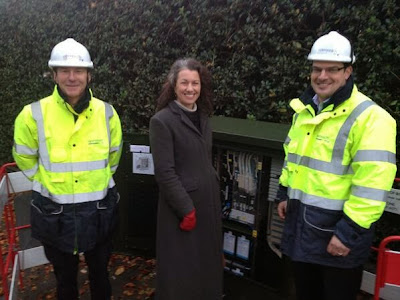
Inspecting the new Moorgate Street cabinet, Rotherham MP, Sarah Champion, said: "To ensure Rotherham's future success we need the right building blocks in place. One of these is having the digital technology to support our people and economy. Super-fast fibre broadband will transform the business sector and attract new inward investment.

"Hundreds of new jobs and business start-ups are expected to be created. With access to fibre broadband, local firms can explore new ways of working and speed up vital operations, to boost their ability to compete."

Research carried out for BT by Regeneris Consulting suggests that in the next 15 years super-fast broadband could give the economy of a typical town a £143m boost, create around 225 new jobs and 140 business start-ups.

Rotherham is also able to access the superfast mobile 4G network. Last week, network operator, O2, switched on its own 4G network in the town. This follows on from Rotherham becoming one of the first areas to get access to rival firm, EE's 4G network in March.

BT Openreach website

Images: BT Openreach

Read more...

Friday, August 16, 2013

News: Closure of Digital Region announced

By

Shareholders in South Yorkshire's pioneering Digital Region project have agreed to halt their search for a private sector partner and begin a managed closure of the fibre optic network.

The superfast broadband network was built for the region by Digital Region Ltd in partnership with technology company Thales UK. The aim of Digital Region was to bring continuous 25mb+ broadband to over 97% of South Yorkshire, including 550,000 homes and 1.3 million people. Work on installing the network started in 2009, and by 2012, completion of phase one of the project saw 80 percent of homes and businesses within South Yorkshire able to be linked to the network.

In a statement, the shareholders said: "Barnsley, Doncaster, Rotherham and Sheffield councils - along with major shareholder, the Government's Department for Business, Innovation and Skills (BIS) - have agreed that a managed closedown of the network and migration of existing Digital Region Limited customers to alternative networks now offers the most cost-effective deal for the public.

"The estimated cost of continuing with the project would be an estimated £95.8m. Closure of the network would save the taxpayer an estimated £12.5m, and potentially more, subject to negotiations with existing contractors and customers.

"Shareholders have been firmly focussed on using Digital Region Limited (DRL) to achieve a significant increase in superfast broadband coverage across South Yorkshire to ensure economic competitiveness did not fall below other parts of the country. This has now largely been achieved by investment by other providers and shareholders had embarked on a re-procurement exercise in March 2012 to facilitate the commercial transfer of the network to another provider.

"Until this point, the costs of closure and the costs of continuing with the project and realising additional benefits for residents and businesses of South Yorkshire were finely balanced.

"Digital Region was established as a pioneering project to deliver major transformational change in the way superfast broadband was delivered across South Yorkshire. When the project was conceived, next generation broadband was not yet available in South Yorkshire, compounding the area's existing economic disadvantages. A visionary solution was needed to a complex and pressing need.

"However, there have been significant developments in the broadband market and it is no longer financially viable to keep the project up and running. The focus will now be on obtaining the best possible deal for taxpayers and ensuring a smooth transition for existing DRL customers to another provider so that services are not disrupted.

"Existing Digital Region customers are being informed, and will be supported over the coming months to switch to alternative service providers to avoid any disruption to services."

Digital Region website

Read more...

Friday, March 8, 2013

News: Bouygues lined up to take on Digital Region

By

French firm, Bouygues Energies & Services, previously known as EDTE SA, has been named as the preferred contractor to take over the Digital Region project in South Yorkshire.

The firm beat off BT during negotiations that saw the EU procurement process ended early.

The superfast broadband network is being built for the region by Digital Region Ltd in partnership with technology company Thales UK. The £90m project includes £30m from the European Regional Development Fund.

The project was wholly owned by the now defunct Yorkshire Forward and the four local authorities of South Yorkshire.

Last year, each authority agreed to a preferred option to enter into a process to procure a supplier to takeover operations and management of the network in order that the network is available to, and used by, as many people and businesses as possible in South Yorkshire.

29 expressions of interest were received in May and following subsequent stages, two bidders continued to progress through the process.

They were BT Wholesale Managed Services and ETDE SA (Entreprise de Transport et de Distribution d'Electricité) the Energy and Services Division of Bouygues Construction.

After it became clear that a best value outcome could not be achieved within the parameters of the complex European Union notice and the uncertainty regarding a number of clarifications required from the EU Commission, Digital Region Ltd decided to end that procurement process and moved to a "negotiated procedure without the publication of a contract notice" in order to achieve its requirements within a tight timeframe.

Discussions continued with the two previous shortlisted bidders and after final bids were received, Bouygues Energies & Services were notified that they had been awarded the contract in January.

If the contract is finalised, Bouygues will take on accountability for all of the revenues, costs and risks associated with delivering and operating the network.

The nine year contract includes an option to transfer title after year six and any profits over and above a jointly agreed level that have been generated through the operation of the network will be returned to loss-making Digital Region Ltd for reinvestment.

Bouygues Energies & Services is one of the European leaders in the field of Public-Private Partnerships, delegated management and service agreements concerning public lighting, digital infrastructures and facility management. It operates over 60 contracts of this kind across the world.

Through its Axione subsidiary, it manages 15 high speed broadband "Public Initiative Networks" in France. Supported by €631m of public and private investment funds they cover 10% of the French territory, reaching 6.5 million people and 310,000 companies.

Digital Region website
Bouygues Energies & Services website

Images: Bouygues

Read more...

Friday, November 2, 2012

News: Service exchange platform goes live in Digital Region

By

A new Service Exchange Platform (SEP) has gone live and added more than 50 additional service providers to the Digital Region network in South Yorkshire.

Through a new fibre optic network, the Digital Region project will bring continuous 25mb+ broadband to over 97% of South Yorkshire, including 550,000 homes and 1.3 million people.

Customers who use the SEP to connect to the network can receive maximum combined throughput speeds of 100Mbps and an unprecedented selection of service providers.

Fluidata, an aggregator of over 50 Internet Service Providers (ISPs), signed up to the Digital Region earlier this year. Fluidata has collaborated with Swedish open access network management specialist, Netadmin Systems and integrator and managed services partner, Magdalene to implement the new SEP.

David Cowell, COO at Digital Region, said: "The service exchange platform offers a real boost for broadband users in South Yorkshire. We built a world-class communications infrastructure and have now added an excellent service provider choice to rival any network in the world.

"The operational support system connecting consumers to these service providers is now as advanced as the fibre network itself. This puts the region in pole position to take advantage of the opportunities presented by the digital economy."

Piers Daniell, director of Fluidata, said: "More than 80 percent of users in Barnsley, Doncaster, Rotherham, Sheffield and the rural areas in-between, now have access to our 50+ ISPs. Not only do the people of South Yorkshire have an enviable network, but they also have access to a very competitive broadband market. This means increased choice for those customers in the region and a larger market for our service providers to access."

The £90m project was wholly owned by the now defunct Yorkshire Forward and the four local authorities of South Yorkshire. It secured £30m from the European Regional Development Fund.

Digital Region website

Read more...

Friday, August 17, 2012

News: Fluidata enhances Digital Region

By

Fluidata, an aggregator of over 50 Internet Service Providers (ISPs), has signed a deal with Digital Region Limited, the company establishing a superfast broadband network for South Yorkshire.

Through a new fibre optic network, the Digital Region project will bring continuous 25mb+ broadband to over 97% of South Yorkshire, including 550,000 homes and 1.3 million people.

The contract enables Fluidata's numerous ISPs to offer superfast broadband services across the network. This will increase the number of services available to business and residential customers.

Fluidata uses its own technology to interconnect ISPs, creating a network (often into areas that are not well served by broadband providers) without each individual ISP having to invest in building their infrastructure. By removing these costs, the associated ISPs can provide services and connections at a lower rate and achieve the best possible service for the end user.

David Cowell, chief operating officer at Digital Region, said: "Signing a deal to bring Fluidata on to the Digital Region network is a great achievement.

"Now that the first build phase of the network is complete and 80% of the region is able to access superfast broadband, our aim is to increase the number of ISPs on the network. We are working on a number of deals that will help transform the region and encourage businesses to locate here."

Piers Daniell, managing director of Fluidata, added: "We are delighted to have signed a contract that allows our ISPs to offer enhanced services in South Yorkshire and gives them the opportunity to utilise such a wide reaching next generation network.

"I'm sure our ISPs will have some fantastic offers for the residents and businesses within the region."

A procurement exercise is currently underway to find a private company to take forward the Digital Region project. BT Wholesale Managed Services and ETDE SA (Entreprise de Transport et de Distribution d'Electricité) the Energy and Services Division of Bouygues Construction were announced as the shortlisted contenders.

Digital Region will move in line with the commercial model being promoted by central government's Broadband Delivery UK (BDUK) for superfast broadband in the rest of the UK. The BDUK commercial model places the majority of risk and liability to a private sector partner. The appointed supplier takes responsibility for all operating costs, sales, marketing and revenue generation.

The £90m project was wholly owned by the now defunct Yorkshire Forward and the four local authorities of South Yorkshire. It secured £30m from the European Regional Development Fund.

Fluidata website

Digital Region website

Read more...
Members:
Supported by:
More news...

  © Blogger template Newspaper III by Ourblogtemplates.com 2008

Back to TOP